

When examining the capital allocation from different investor types, ocean specialists account for just 3% of the venture capital directed toward blue economy startups.
Sponsored by


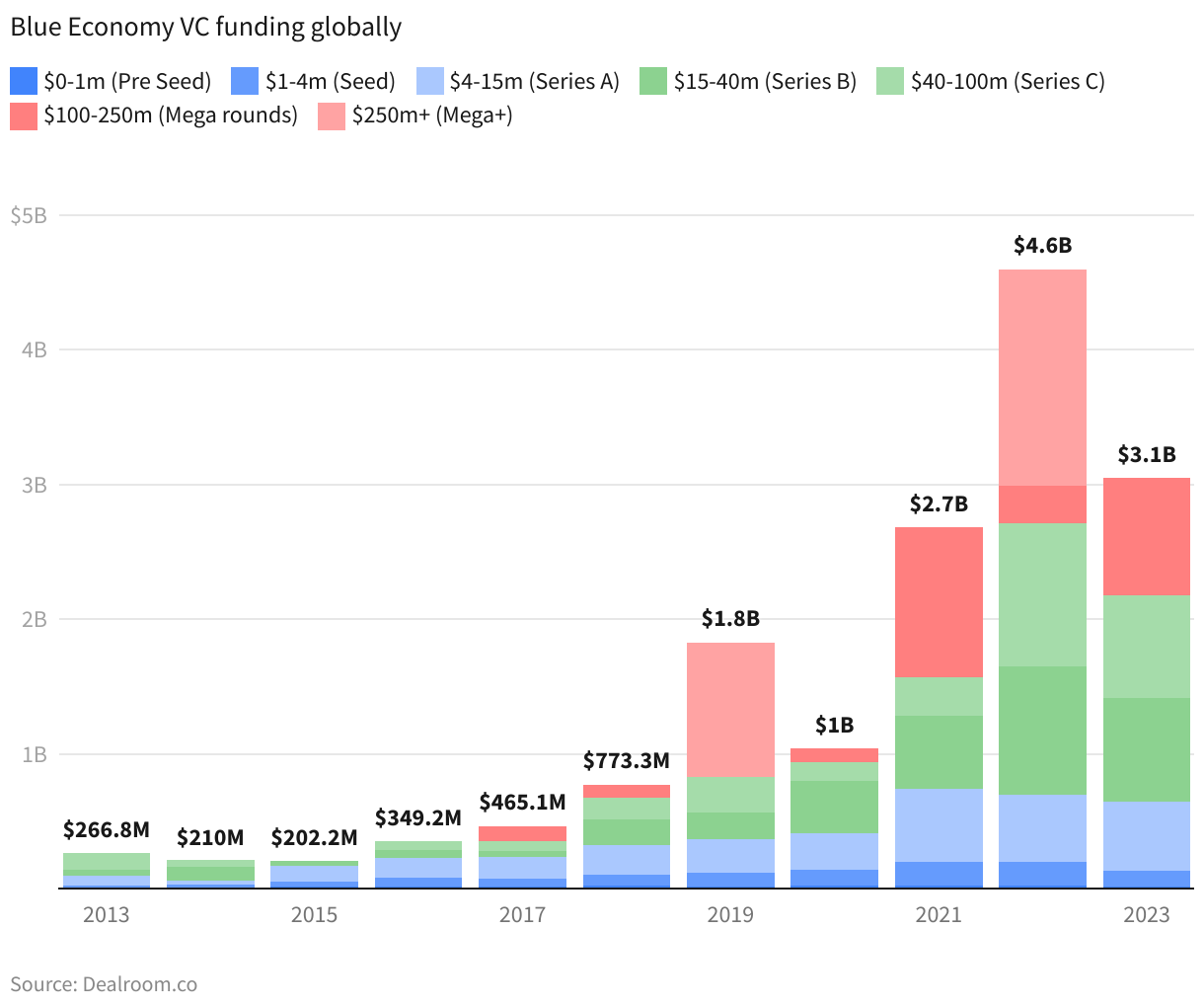 When looking beyond shipping and ports, the rest of Blue Tech attracted $1.1B so far in 2024, a projected 50% decline from the previous year's record high.
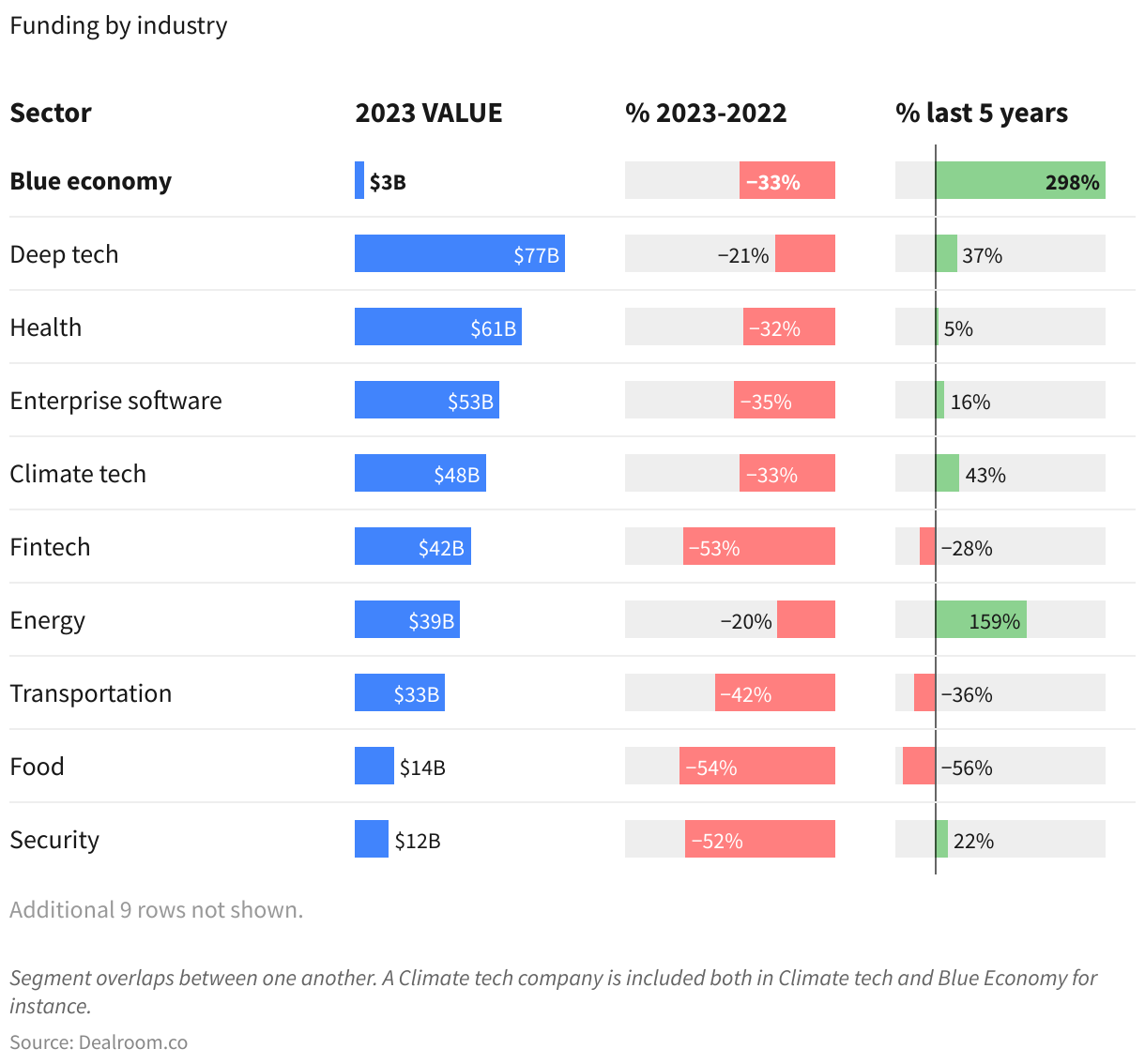 The Blue Economy ecosystem is still in an earlier stage of development with respect to more mature VC markets like fintech or even the broader climate tech space. Nonetheless, it is making up a growing share of global climate tech funding, reaching a record high 5% in 2023.
A higher % of blue economy startups have been founded in the last five years and the number of early-stage rounds far out numbers exits still in contrast with mature segments like fintech.
The Blue Economy ecosystem is still in an earlier stage of development with respect to more mature VC markets like fintech or even the broader climate tech space. Nonetheless, it is making up a growing share of global climate tech funding, reaching a record high 5% in 2023.
A higher % of blue economy startups have been founded in the last five years and the number of early-stage rounds far out numbers exits still in contrast with mature segments like fintech.
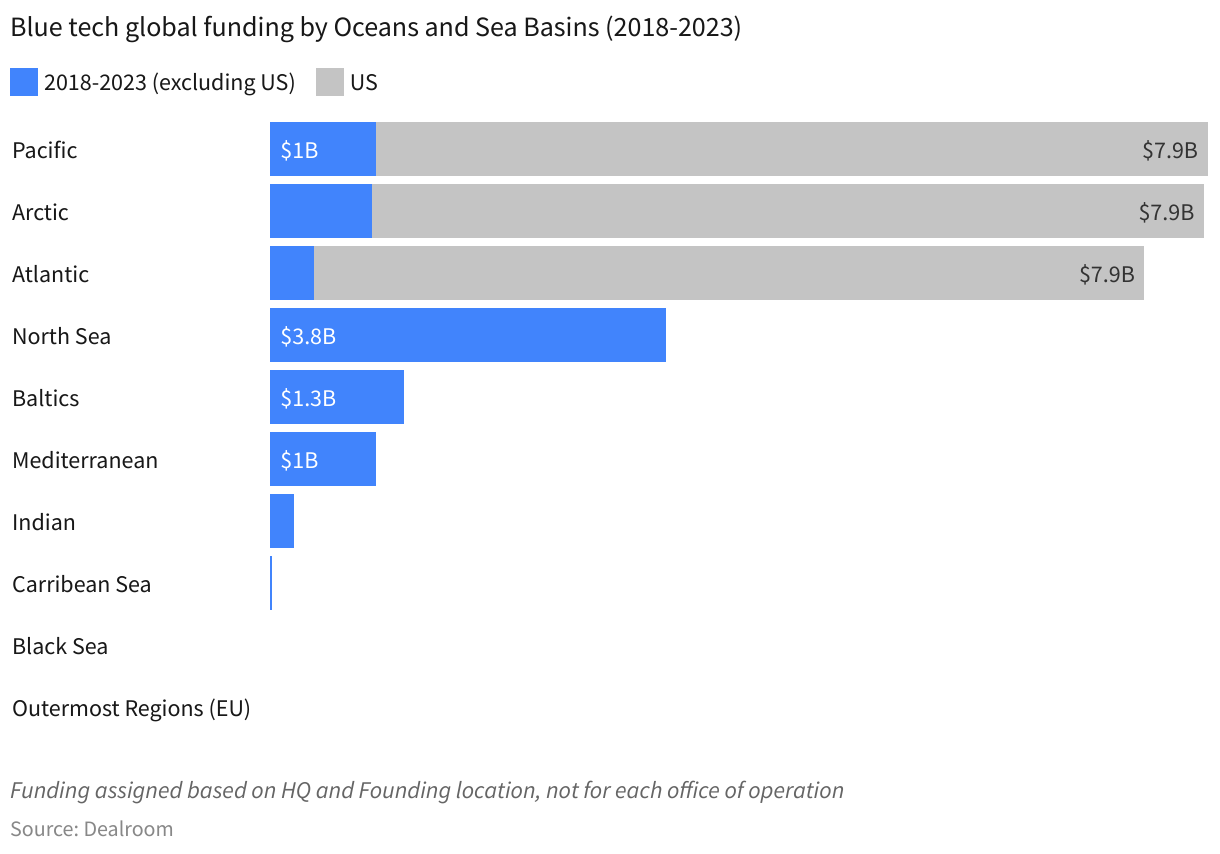 You can explore each of the Oceans and Sea Basins on the Hub Azul platform.
Key companies operating within this field on the abiotic side include Captura (using direct ocean capture, DOC, by extracting carbon absorbed by the ocean surface), Ebb Carbon and Heimdal (electrochemical ocean alkalinity enhancement by pumping out seawater and removing carbon), Limenet (using a carbon mineralization method able to transform the carbon dioxide collected from the atmosphere or other sources into an aqueous solution of calcium bicarbonates which helps ocean alkalinity).
On the biotic (nature-based solutions, NBS) side, most attention has been toward kelp and algae, with startups such as CarbonWave (large-scale Sargassum seaweed plantation to capture carbon and replace petrochemicals materials) and Brilliant Planet (which grows, dry and bury algae in the desert to remove carbon permanently).
Explore 95+ Ocean environmental protection and regeneration startups.
 Explore the full landscape here
 Leading accelerator and investor in impact startups and blue economy.
 HUB AZUL Dealroom: a global ecosystem connecting blue innovators with investors
Forum Oceano: Portugal Blue Economy Cluster
HUB AZUL Dealroom: a global ecosystem connecting blue innovators with investors
Forum Oceano: Portugal Blue Economy Cluster
What is the Blue Economy?
The Blue Economy, or the ocean economy, is a term used to describe the economic activities associated with the oceans and seas. The World Bank defines the blue economy as the “sustainable use of ocean resources to benefit economies, livelihoods and ocean ecosystem health”, and the European Commission as “all economic activities related to oceans, seas, and coasts. It covers a wide range of interlinked established and emerging sectors”. The Blue Economy has existed for millennia and posed the base for developing a large part of our civilization. However, current economic trends have been rapidly degrading ocean resources. In response to this, a new generation of startups is now emerging to tackle the huge potential of the Blue Economy in terms of sustainable resource production and climate change mitigation for tremendous and regenerative blue growth. In the last few years, most funding has gone into shipping and ports, such as freight forwarding and supply chain management solutions, especially in 2021-2022 after the pandemic supply chain disruptions. Bluetech and ocean observation (mostly autonomous defense vessels), Shipping and ports and Shipbuilding and refit have instead dominated funding in 2024.Why do oceans matter?
Covering two-thirds of the planet, the oceans play a vast role in the climate system. They have absorbed about 90% of the extra energy caused by global warming due to fossil fuels. As a result, the top 700 meters (2,300 feet) of the global ocean have warmed about 1.5°C since 1900. This, coupled with overfishing and pollution, is causing a rapid biodiversity decline in the ocean. In the latest assessment of global marine species, nearly 10% were found to be at risk of extinction, according to the International Union for Conservation of Nature (IUCN). Populations of marine vertebrates, specifically, (mammals, birds, fish and reptiles) declined by 49% since 1970, and 90% of stocks of large predatory fish, such as sharks, tuna, marlin, and swordfish, have already disappeared. The ocean also absorbs nearly one-quarter of all carbon emissions. However, due to all this carbon dioxide, it has become 26% more acidic since the 1940s (its pH has changed from 8.2 to 8.04 in 2020). In terms of VC funding, blue carbon removal solutions are growingly taking space in the broader carbon removal sector, reaching a record high 13% in 2024. Continuing on the same trend, pH in 2045 will drop to 7.95, a level at which it is estimated that 80% to 90% of all remaining marine life will be lost, triggering an irreversible tipping point for oceans.Loading chart…
Economically, oceans represent a fundamental asset globally. The World Wide Fund for Nature (WWF) report conservatively valued the then-known “asset base” of the ocean at USD 24 trillion yearly, with USD 2.5 trillion in goods and services from coastal and oceanic environments – equivalent to the 7th largest economy by GDP in 2015.
Over 80% of international trade is carried by sea, and the percentage is even higher for most developing countries.
Furthermore, more than 3.5 billion people depend on the ocean for their food security, and approximately 350 million jobs are created in ocean-based sectors.
When it comes to our climate transition, the ocean should be considered a key player both in adaptation and mitigation strategies against climate change. Oceans can help generate renewable energy through offshore wind and marine energy, helping to transition away from fossil fuels.
Oceans are also important vehicles to remove and store carbon dioxide (CO2) from the atmosphere in natural systems.
Finally, protecting and restoring ocean ecosystems, making fisheries and aquaculture climate-ready, and enhancing the resilience of coastal areas will all contribute directly to adapting to climate change's impacts on the ocean and communities.
Blue Economy VC Trends
In recent years, there has been a major increase in awareness around oceans. The Blue Economy ecosystem has seen significant growth, projected to reach $2B in 2024. Blue economy VC funding has grown over 4x in the last 8 years.VC allocation by stage
Below we break venture capital into three distinct stages:- Startup stage ($0-15M rounds)
- Breakout stage ($15-100M rounds)
- Scaleup ($100M+ rounds).
Loading chart…
Early-stage investment
Explore early-stage investment into the Blue Economy here on the app.
Loading chart…
Breakout-stage investment
Explore breakout-stage investment into the Blue Economy here on the app.
Loading chart…
Late-stage investment
Explore late-stage investment into the Blue Economy here on the app.
Loading chart…
Comparison with other industries
Blue Economy has been one of the fastest growing venture capital sectors, with a nearly 300% increase in the last six years, followed by Energy and Semiconductors. It is still a much smaller overall market than many others. Climate tech attracted 16x more funding in 2023, but it is now nearly on par with industries such as Gaming, Travel, and Education. You can sort the table below by clicking on the columns.Top countries and regions
The Nordics are the countries with the most share of funding going into the Blue Economy. Portugal and Mexico also show a strong focus on the blue economy.Loading chart…
The US leads ahead of Europe for bluetech VC funding in 2024, with all regions showing a drop from the previous year. Bluetech funding is still heavily concentrated with these two regions accounting for 88% of all investments in 2024.
The US is the leading country for 2024 blue economy investments, followed by France, Norway and the Netherlands.
Indonesia's strong growth is mostly led by aquaculture companies such as Efishery.
Oceans and Sea Basins
When analyzing the Blue Economy, we need to look beyond countries, regions, and continents to also Oceans and Sea Basins. Often, industry associations, partnerships and intercountry agreements are, in fact, shaped around these areas of operation. Considerable overlap exists among the different areas, with for instance US and Canada active in all Atlantic, Artic and Pacific regions, and Nordic countries such as Sweden and Norway active in both North Sea and Artic Sea. Since 2018, the Artic, Pacific and Atlantic, have attracted the most funding, mostly driven by the US. Looking beyond the US, The North Sea saw the strongest investments.Blue Sectors
We break down the Blue Economy into 10 segments and over 30 subsegments, here we will focus on 3 segments, for the full breakdown see the Blue economy guide. Explore the interactive chart by navigating the changes through the years. You can also click on a segment to zoom in and see the subsegments inside better.Blue Renewable Energy
VC funding in Blue renewable energy startups has grown from less than $100M per year in 2018-2020 to approximately $300M in 2022 and 2023. However, 2024 is projected to decline at least 3 fold compared to these record highs. Nearly $1B have been invested since 2016. Offshore wind attracted nearly 3/4 of all Blue renewable energy funding. This is not surprising since offshore wind is the most mature of the ocean's renewable energy sources. In the US, it is estimated that offshore wind potential exists for over 4,000 GW of capacity —more than three times the country’s installed electricity generation capacity. Companies in the field include Venterra (offshore wind services), Gazelle Wind Power (hybrid floating offshore wind platforms), and Principle Power (wind turbine agnostic floating platform). Wave and tidal energy is still in the early stages of development despite having the potential to exceed the global power demand of 22,848 TWh/y. There are several methods of producing energy, and they commonly involve placing electricity generators on the ocean's surface, but also submarine installations. Ever since its uptake in 1973, several conversion technologies were introduced in the market, with different characteristics and deployment suitability. Companies operating within this field include AW-Energy and CorPower Ocean. Even more nascent is the segment of ocean thermal energy, which exploits thermal energy harvesting systems to create electricity underwater from temperature differences in the ocean. Early innovators include Seatrec and Global OTEC Resources. Floating solar panels are also gaining interest from investors, with a record $18M of funding in 2023, up from nearly nothing in 2018-2019, but the sector is still in a very early stage. Examples of companies include Solar Duck and Oceans of Energy. Some of the main advantages of floating solar are space utilization (no land use) and better efficiency, thanks to the cooling effect from water. However, they also suffer from typical offshore installation challenges such as high maintenance and infrastructure costs (foundation, grid connection, etc). Floating solar accounted for less than 1% of total solar installations in 2022 and accounted for only 0.003% of all solar energy VC funding in 2023. Overall, Blue renewable energy attracted less than 2% of global renewable energy VC funding in 2024. Marine energy can be a challenging resource to harness: salt water and sediment could damage ocean-bound machines; devices must be able to withstand strong wave and tidal conditions; and deploying or servicing devices offshore can be costly in terms of time and money. Hence, higher costs, natural barriers and lower technology readiness play an important role in the development of this market. Explore 120+ Blue renewable energy startups.Bluetech and ocean observation
VC funding in Bluetech and ocean observation has already reached a record high of $368M in 2024, a 135% increase from 2023. Over $1.5B have been invested since 2016. Drones, surface and subsea robots have attracted 70% of the funding in the sector. Example of companies include Saildrone (operating fleets of autonomous surface drones for defense and ocean mapping), Bedrock Ocean Exploration (autonomous vehicles for seafloor mapping), Skyspects (drones for offshore wind turbines inspection and maintenance), and Tekever (drones for monitoring of ocean activities). Space tech for maritime monitoring is also attracting considerable funding, such as Unseenlabs, which enables the tracking of maritime vessels at any location using satellite data. Another interesting segment is underwater communication, such as Wsense. Explore 135+ Bluetech and ocean observation startups.Blue biotechnology
Blue biotechnologies, or marine biotechnologies, are processes that transform marine resources into services and goods in a multitude of fields. These include microorganisms (microalgae, bacteria, and fungi), seaweed & algae, and invertebrates (e.g., starfish, sea cucumbers, and sea urchins). VC funding in Bluetech biotechnology peaked at over $300M in 2022 and is now projected to drop 45% by 2024's end. Over $1B have been invested since 2016. Half of the funding into this segment went into seaweed and algae startups for a variety of applications. Applications range from pharma (Lumen Bioscience uses a patented technology to use the well-known food algae spirulina to deliver therapeutic proteins), food (Brevel develops microalgae-based alternative proteins), feed supplements for cow methane emission reduction (CH4 global) and biomaterials & biofuels (Viridos produces sustainable, low-carbon, algae-based jet and diesel fuel; Sway seaweed-based bioplastic). Beyond seaweed and algae, some startups are exploiting other marine resources for innovative applications, such as Jellagen, which uses jellyfish to produce Collagen Type 0 for complex tissue engineering and regenerative medical needs, and Hemarina which develops marine oxygen carriers for industrial and therapeutic applications based on the particularities of purified hemoglobin from lugworms, Arenicola marina. Explore 270+ Blue biotechnology startups.Ocean environmental protection and regeneration
VC funding in Ocean environmental protection and regeneration has increased strongly in the last three years, with the first companies in the segment starting to raise Series B+ rounds. Over $400M have been invested since 2016. The ocean is one of the main repositories of the world's biodiversity, counting over 90% of the habitable space on the planet and contains some 250,000 known species. Such biodiversity is crucial for innumerable life aspects, from social to economic and environmental. Yet, just 3.4% of the ocean is protected, and only part of this is effectively managed. As a consequence, nearly 10% of marine species are found to be at risk of extinction, with climate change impacting at least 41% of threatened marine species. Populations of marine vertebrates, specifically, (mammals, birds, fish and reptiles) declined by 49% since 1970.Loading chart…
Over $200M since 2016 has been invested into ocean biodiversity protection and tracking, across biodiversity tracking startups such as Spoor (SaaS data platform that enables continuous monitoring of wildlife for offshore wind farms, pre and post construction), and biodiversity regeneration startups such as Urchinomics (which removes overgrazing sea urchins which helps turn a barren seafloor back into a vibrant kelp forest), and Coral Vita (using proprietary technology to grow resilient corals 50x faster to restore dying reefs.).
Ocean carbon removal (CDR) is also starting to pick up, with a record $55M raised in 2024. This accounted for 13% of overall carbon removal, which has so far mostly focused on land, a still low share but the highest historically.
Oceans are in fact naturally key carbon sinks, absorbing nearly one-quarter of all carbon emissions. This has, however, caused the ocean to become 26% more acidic since the 1940s (its pH has changed from 8.2 to 8.04 in 2020) and might see a drop to 7.95 by 2045, a level at which it is estimated that 80% to 90% of all remaining marine life will be lost, triggering an irreversible tipping point for oceans.
Ocean CDR aims, therefore, to leverage the ocean’s natural chemical and biological processes to capture and remove carbon from the atmosphere while often also reducing the adicity (enhancing the alkalinity) of the ocean.
Ocean CDR spans a wide range of approaches, each with different levels of scientific reliability and efficacy. Overall, seven main approaches are thought to be the most effective and scalable from biotic approaches such as coastal wetland & mangroves restoration and seaweed (especially kelp) cultivation, to engineered approaches like alkalinity enhancements and electrochemical CO2 removal.
Top investors, accelerators and ecosystem actors
Top Investors
Blue economy specialists and climate tech VCs make up the most active investors in the sector. Notable is also the strong activity of SOSV, a generalist fund with a strong climate activity focus.Loading chart…
Top Accelerators
Blue economy specialists and climate tech accelerators are the most active early supporters of blue economy startups.Loading chart…
Top Blue economy investors and funds
Explore the full landscape here
Fund analysis
This year, nine funds have already been raised specifically to support ocean-related startups, with projections indicating they will total $1.4 billion by year’s end - a record high.Loading chart…
Loading chart…
Public Blue Economy initiatives
Despite such challenges, the last years have seen important improvements and initiatives rising both in the public and private realms. We have summarized below a list of the main institutional and public initiatives created in recent years that are inevitably connected with the unfolding of private ocean-tech innovations. The ‘BlueInvest’ investment platform was launched by the European Commission in April 2019, with the goal of fostering investment, innovation and sustainable growth in the Blue Economy. The platform supports innovative SMEs and start-ups active in the Blue Economy sectors, through its online community, investment readiness assistance, matchmaking, investor outreach and engagement, its academy, projects pipeline and a BlueInvest Fund. The 1000 Ocean Startups coalition was launched in 2021 and unites the global ecosystem of incubators, accelerators, competitions and investors supporting startups for ocean impact. The Convention on Biological Diversity’s (CBD) Fifteenth Conference of the Parties (COP 15), which took place in Montreal from December 7 to 19, 2022. Here, countries pledged to protect 30% of the ocean, land and coastal areas by 2030 (known as ‘30×30’). This was a first important step to bridging the blue economy and climate regimes, enabling the UN 2030 Agenda for Sustainable Development. In 2023, member states of the United Nations agreed to a High Seas Treaty that ensures the protection and sustainable use of marine biodiversity in areas beyond national jurisdiction. For the first time in history, rules will be in place to effectively manage and govern oceans. The High Seas Treaty includes an agreement to impose strict ocean protection outside national borders and rules for the sustainable use of its resources. Ocean Climate Action Plan in the USA. The OCAP is a policy framework introduced in 2023 under the Biden-Harris Administration to safeguard oceans and coastal communities. The Ocean Climate Action Plan entails deploying offshore energy infrastructure (wind & marine energy); investing in marine conservation through nature-based solutions and carbon removal; and decarbonising marine shipping and transportation.Partners
Leading accelerator and investor in impact startups and blue economy.
Katapult VC is a global investment company focusing on early-stage impact-driven technology startups. Katapult has, over the last 5 years, made 178 investments in impact tech startups from 47 different countries. Katapult invests within three investment verticals: Ocean, Climate and Food-tech.
Katapult has run nine flagship accelerator programs and three corporate accelerator programs.
In 2021, Katapult also launched the Katapult Foundation with the aim of building a larger network around impact investing. Katapult also hosts the annual Katapult Future Fest in Oslo, bringing together founders, investors and some of the most prominent figures within the impact investment sector.
HUB AZUL Dealroom: a global ecosystem connecting blue innovators with investors
Hub Azul Dealroom is the digital platform for the global internationalization of Portugal's Blue Economy, ignited by Fórum Oceano (Portugal's Blue Economy Cluster), in articulation with the Strategic Management Council presided by the Directorate General for Maritime Policy of the Ministry of Economy and Sea of Portugal.
Hub Azul Dealroom is financed by the Next Generation EU Fund - Recovery and Resilience Plan of Portugal.
Fórum Oceano is the entity that manages the Portuguese Sea Cluster.
Fórum Oceano's mission is to reinforce strategic cooperation dynamics between actors – companies, RTD centres, higher education institutions, Public Administration bodies – to promote innovation, qualified employment and the competitiveness of companies that use the Sea and marine resources as central elements of their activity.
As part of its mission, Fórum Oceano intends to contribute to the digitization, decarbonisation and circularity of the Sea Economy’s production processes.
Related Content
Impact Methodology & Definitions: Learn how Dealroom defines impact here. Platform: Explore our Blue Economy platform. Full Blue economy guide