 T
Terrestrial Energy
Integral Molten Salt Reactor Technology
About Terrestrial Energy
Terrestrial Energy is a nuclear technology company founded in 2013, with a U.S. headquarters in Charlotte, North Carolina. The company was co-founded by David LeBlanc, who serves as Chief Technology Officer, and Simon Irish, its Chief Executive Officer. LeBlanc is a recognized authority on Molten Salt Reactor (MSR) technologies, having focused his academic and professional career on advancing nuclear power systems. His journey began in the mid-1990s while pursuing a Ph.D. in physics, where he became fascinated with MSR designs from Oak Ridge National Laboratory. Irish brought two decades of global investment banking and management experience to the venture, having previously led a multi-billion-dollar investment business in North America. In 2010, he pivoted to focus on breakthrough energy technologies, identifying the commercial potential of Generation IV fission.
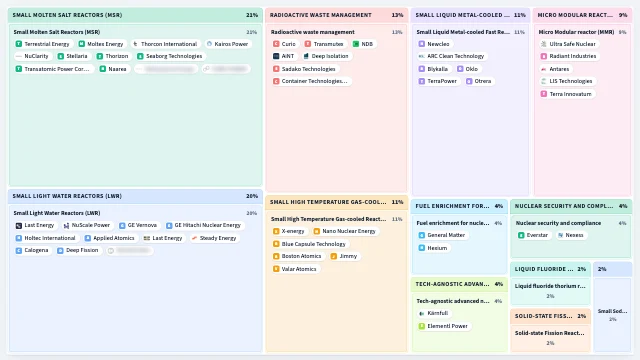
The company is focused on developing and commercializing its proprietary Integral Molten Salt Reactor (IMSR), a Generation IV small modular reactor (SMR). The IMSR plant is engineered to provide cost-competitive, zero-carbon thermal energy at high temperatures, suitable for both electricity generation and industrial heat applications. This dual-use capability targets a wide client base, including data centers, industrial heat and power users, grid-scale power providers, and the green fuels sector. Terrestrial Energy’s business model is structured around long-term revenue streams spanning a plant's 50+ year lifecycle. This includes engineering and construction services, the supply of critical components like replaceable IMSR core-units every seven years, fuel supply, and ongoing operations, maintenance, and decommissioning services.
The core of Terrestrial Energy's offering is the IMSR, which builds upon proven MSR technology developed at Oak Ridge National Laboratory. Unlike conventional reactors that use solid fuel and high-pressure water coolants, the IMSR employs a liquid fuel—a mixture of standard-assay low-enriched uranium and a carrier salt—that also serves as the coolant at low pressure. This design delivers significant safety and efficiency advantages. The reactor operates at higher temperatures (around 585 degrees Celsius), enabling a nearly 50% improvement in electricity generation efficiency compared to traditional light-water reactors. A standard plant configuration uses two reactors to produce just under 400 MW of electricity or over 800 MW of thermal energy. A key feature is the integration of primary components into a compact, sealed, and replaceable Core-unit, which simplifies design and shortens construction time to an estimated four years. The company has received significant regulatory validation, completing a multi-year Vendor Design Review with the Canadian Nuclear Safety Commission in 2023, a first for a molten salt reactor.
Source: Dealroom company dataAt a glance
- Status
- Listed
- Founded
- 2013
- Headquarters
- Charlotte, United States
- Listing
- Public via SPAC 2025
- Sector
- Energy
- Power Law
- Unicorn$1–10B valuation tier
Knowledge graph
More headlines
Investors
From Dealroom's funding and investor records, grouped by the round each investor first entered.
Seed1 investor entered at this stage
 US Department of Energy
Series A1 investor entered at this stage

Series B and later1 investor entered at this stage
- HCHCM II Acquisition Corp
Source: Dealroom Talent Intelligence.
Global footprint
team presence
across markets
Patents
9 active patent families included in this estimate.
A patent family groups patent filings for the same invention. Source: Dealroom · PatSnap.
Market sentiment
An AI-synthesised read of the highest-engagement posts about Terrestrial Energy on X, ranked by likes and reposts, corporate channels excluded.
Reading the room on X — pulling top posts and synthesizing themes…
Source: X recent search ranked by engagement (likes + retweets) · Synthesis by Claude · Cached for 1 hour
See Terrestrial Energy on the full Dealroom platform
Live deal flow, founder pedigree, hiring signals, revenue trajectory, and the full cap table.