 R
R
Radiant Industries
Portable, failsafe nuclear microreactors for clean energy.
About Radiant Industries
Radiant Industries is an energy technology company developing and manufacturing portable, factory-built nuclear microreactors designed to replace diesel generators in a variety of applications. The company was founded in 2020 by former SpaceX engineers Doug Bernauer and Bob Urberger. Bernauer, the CEO, was inspired to start the company after researching power generation options for a potential Mars colony while at SpaceX, where he recognized a need for small, transportable nuclear reactors. He and Urberger, the CTO, leveraged their experience in aerospace engineering to address this gap, initially funding the company themselves before securing their first angel investment in late 2020. Radiant's core product is the Kaleidos microreactor, a 1-megawatt electric (MWe) high-temperature, gas-cooled reactor (HTGR) that is small enough to fit within a standard shipping container. This design allows for transport by truck, sea, or air for rapid deployment to remote locations. A key feature of the Kaleidos reactor is its use of tristructural-isotropic (TRISO) particle fuel and a helium coolant, which contributes to its failsafe design and eliminates the need for water, allowing it to be sited almost anywhere. Each reactor is designed to operate for up to five years before being returned to a Radiant factory for refueling and refurbishment, part of a 20-year operating lifecycle. The company targets a diverse client base, including military installations, remote communities, data centers, disaster relief operations, and critical infrastructure like hospitals. Radiant has secured significant contracts with the U.S. military, including agreements with the U.S. Air Force to deliver a unit to Buckley Space Force Base and a $750 million contract with the U.S. Army to deploy 15 Kaleidos reactors by 2030. Commercially, data center company Equinix has signed an agreement to purchase 20 Kaleidos units. Radiant is on a fast-track development and commercialization path. The company was selected by the U.S. Department of Energy (DOE) to test its first demonstration reactor, the Kaleidos Development Unit (KDU), at the Idaho National Laboratory (INL) in 2026. The demonstration unit was shipped to the INL facility in August 2026. To support mass production, Radiant is constructing a factory, dubbed R-50, in Oak Ridge, Tennessee, with the goal of producing 50 reactors per year. As of late 2025, the company had raised over $575 million in total funding from investors including Andreessen Horowitz, DCVC, Draper Associates, and Founders Fund.
Source: Dealroom company dataAt a glance
- Founded
- 2019
- Headquarters
- El Segundo, United States
- Sector
- Defence
- Power Law
- Unicorn$1–10B valuation tier
Knowledge graph
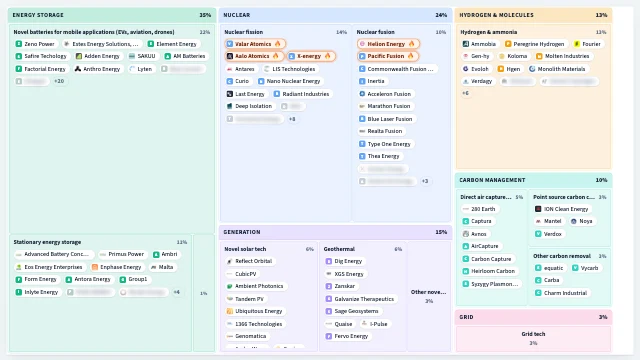
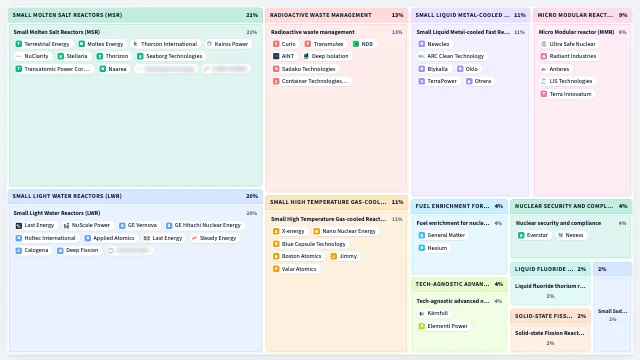
More headlines
Investors
From Dealroom's funding and investor records, grouped by the round each investor first entered.
Seed5 investors entered at this stage
 Tom McInerney
 Charlie Songhurst
 Josh Manchester
 Hank Vigil
 US Department of War
Series A2 investors entered at this stage

Series B and later22 investors entered at this stage
 Andreessen Horowitz
 Cantos Ventures
 McKinley Capital Partners
 Boost VC
 Decisive Point
 Draper Associates
 Founders Fund
 Felicis
 Chevron Technology Ventures
 Washington Harbour Partners
 StepStone Group
 Align Ventures
 HartBeat Ventures
- SCSGA Capital
 ARK Invest
 Giant Ventures
 Crossbeam Venture Partners
 Gigascale Capital
 Pax Ventures
 Lockheed Martin Ventures
 Friends & Family Capital
 In-Q-Tel
Source: Dealroom Talent Intelligence.
Global footprint
team presence
across markets
Market sentiment
An AI-synthesised read of the highest-engagement posts about Radiant Industries on X, ranked by likes and reposts, corporate channels excluded.
Reading the room on X — pulling top posts and synthesizing themes…
Source: X recent search ranked by engagement (likes + retweets) · Synthesis by Claude · Cached for 1 hour
See Radiant Industries on the full Dealroom platform
Live deal flow, founder pedigree, hiring signals, revenue trajectory, and the full cap table.